

Disclaimer: This article does not discuss the five-part masterpiece by Pink Floyd, or your household pet. I’m still working on the words to describe the beauty we hear in those lead lines and the joy we feel when our best friend shows excitement due to our presence alone. I may never succeed in that task, because my perception is my own. Not yours, and certainly not anything that an LLM can truly understand.
The Six-Dollar Chair
In 2010 I was nineteen, a college dropout, and I got my haircuts at a school whenever a relative would say “boy, you’re looking shaggy today”. I didn’t (and still don’t) wear long hair well. EQ School of Hair Design in Council Bluffs (now SOHO Hair Academy ) charged six dollars if you let a student cut while an instructor watched. I could stomach six dollars, even as a part-time retail worker.
One afternoon the student finished, stepped back, and waved her instructor over, proud of the work. He leaned in and found a single hair she had missed along the neckline. He did not just snip it and send me on my way. He turned to her and said, “Honey, you missed one here. Men are like dogs. If you give them what they want, they’ll always come back. Reliable quality is the goal. If they go home and their girlfriend tells them something’s off, they’ll get their next haircut somewhere else.” She fixed it. He checked it again. I came back three weeks later for the exact same thing.
The instructor’s words have stuck with me ever since.
Back then I made $8.50 an hour at Menards , a 17.24 percent raise over the $7.25 I pulled at Pizza Hut in high school. (Iowa’s minimum wage is still $7.25 today, in 2026, but that is a different essay for a different day.) I drove a beat-up $900 Ford Contour I bought from a man with a sign that said “Pitbull with AIDS” in his front yard to deter would-be thieves. I kept my boxes of CDs, and concert ticket stubs in a canister wrapped in a Super Mario wristband I had purchased from Hot Topic (oh, what a time) - my proof of experience. At Menards I wore a blue vest and sold kitchens, building cabinet and appliance layouts in AutoCAD through an absurd run of clicks and keystrokes until I could turn the monitor around and show a homeowner a render of what their kitchen could become. I was already doing by hand, slowly, the thing AI now does in a second: turning a vague want into a finished picture. I just did not know yet that the picture was the easy part.
The Lesson
The instructor was not really talking about hair. He was teaching that quality is the discipline of finding the stray hair before the customer’s girlfriend does. The work is finished only when there is nothing left to catch. I didn’t have a girlfriend at the time, so I’m not certain anyone would’ve caught it for me, but I’m grateful for his words.
I heard the same lesson in three accents in the years that followed. Tom Groepper ran the busiest Menards in the chain, and he still does (at least as of my last visit to their newer, bigger location on the other side of town). He told everyone the same thing: “The customer is here to solve a problem. Your mission is to solve it in one shot. If they ask for drywall screws, send them home with the mud they need to patch that hole in their wall.” At a second job at Cabela’s, a manager put it another way: “These aren’t needs, they are desires. Understand what the customer truly wants before you recommend a product to them.”
Three jobs, one lesson. Think of the screws as information. The mud as judgment. Taste is the sense of sending the customer home with drywall mud to patch the hole left behind by the screw, so that he doesn’t have to make two trips on a Saturday to fix the wall in his home. None of it arrived as a download, or was purchased through a twenty-dollar a month subscription. It came from someone older standing over my work, catching what I missed, then letting me try again. Allan Collins and John Seely Brown named that loop cognitive apprenticeship in 1989: model, coach, scaffold, then fade. That instructor faded, but his words never did. Three weeks later I judged the back of my own neck in the mirror and caught the stray hair myself. The customers at these stores continue to come back, because they trust that their needs will be met, at a price that feels fair to them.
That is taste: repeatable judgment about quality you can run before anyone hands you the answer. A lot of sharp people are arguing right now that this faculty is the new moat, the scarce asset once making things gets nearly free. They are right, but they skip where taste comes from, and what happens to it when we automate away the chair, the instructor, and the stray hair.
Crutch or Coach?
There is always slop, and there is far more of it now. What bothers me about this wave is not the quality of the prose. Most of it is perfectly competent. It is also tiring, a haircut with the stray hair left in, printed millions of times per day.
The headlines say the tools are making us worse, and they are not all noise. In June 2025 an MIT Media Lab team led by Nataliya Kosmyna published “Your Brain on ChatGPT,” and the group writing essays with a language model showed the weakest neural connectivity of any condition. The authors called it “cognitive debt.” Microsoft and Carnegie Mellon University researchers surveyed 319 knowledge workers in 2025 and found that the more a worker trusted the AI, the less critical thinking they did, sliding from solving problems to verifying output. I want to be careful, because the doomer read is its own kind of slop. The Massachusetts Institute of Technology paper is a 54-person preprint that has already drawn a published critique. But I recognize what these studies are getting at. They are measuring what happens when you offload the reps, and the reps are exactly what these tools remove most easily. Cognitive debt is the bill that comes due in the moment. There is a slower one. Call it taste debt: what you never build because you leaned on the machine from the start. You cannot catch the stray hair you were never trained to see.
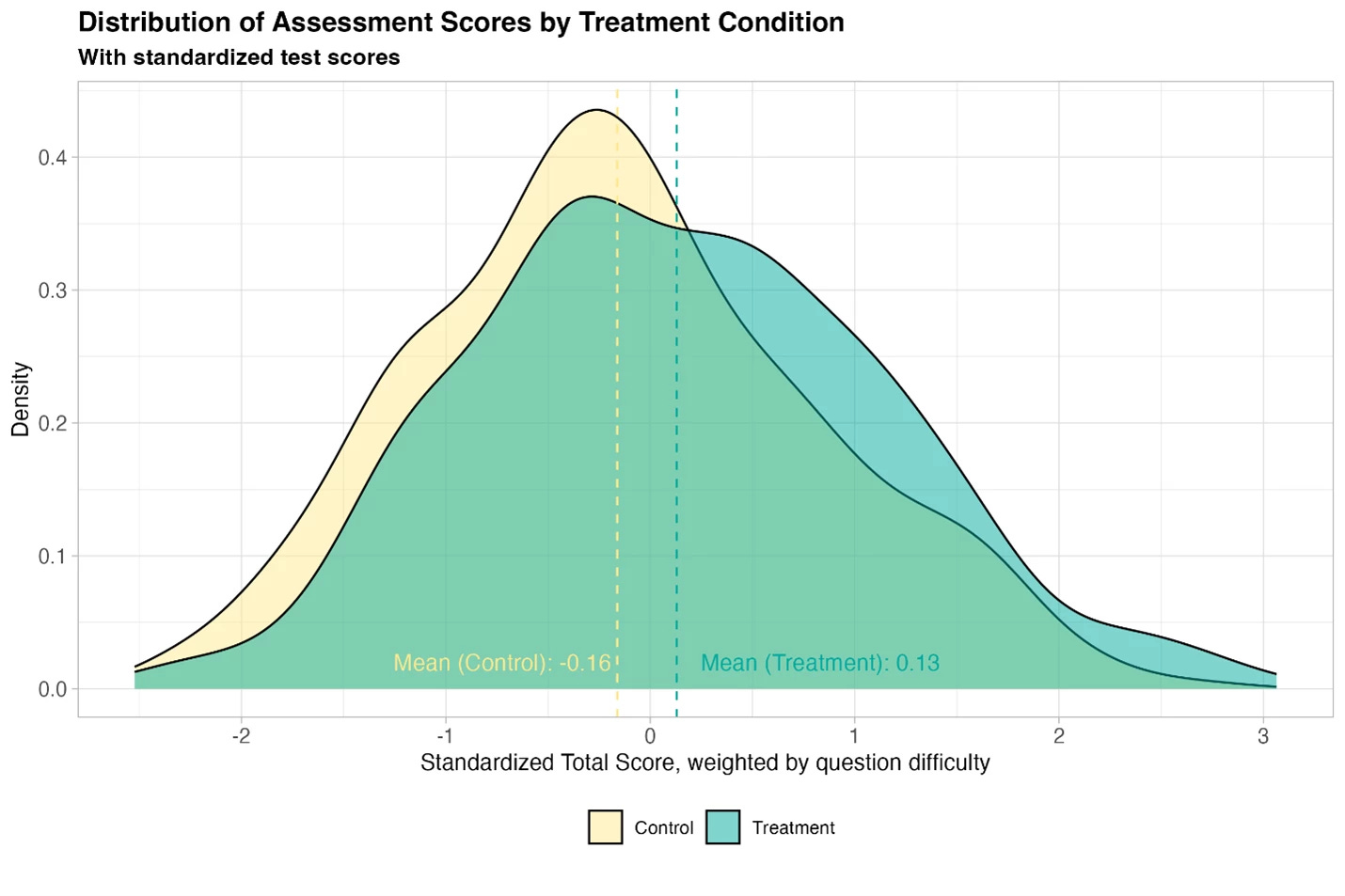
The fix is not to swear off the tool, and there is evidence for that too. Hamsa Bastani and colleagues at The Wharton School, in a 2025 PNAS study titled “Generative AI Without Guardrails Can Harm Learning,” ran nearly a thousand high school students through math with one of two AI tutors: a plain chatbot that handed over answers, and one tuned to give hints. While students had access, both helped. Then the tools were taken away for the exam. The students who used the answer machine scored 17 percent worse than students who never had AI at all. The students who used the hint-giving tutor kept their gains. Same model, opposite outcomes, and the only variable was whether the design made students think or thought for them. A crutch and a coach can be built from the same parts. When the design is right, the upside is real: a 2025 World Bank trial in Edo State, Nigeria, paired students with an AI tutor using OpenAI‘s GPT-4 model for six weeks and measured gains equivalent to about two years of schooling.
So both extremes are wrong. AI will never take my taste, and it genuinely makes me faster, for the same reason: the friction is still required. We still need to learn. The machine cannot do that for us. What it can do is strip away the friction that was never teaching us anything. Robert Bjork calls the useful kind desirable difficulties, and he is explicit that not all difficulty is desirable. Most of those thousand AutoCAD clicks were extraneous load in John Sweller’s sense, teaching me nothing about whether the kitchen was good. Hand those to the machine. Protect the judgment underneath. One limit, because the prescription does not land the same for everyone: researchers led by Slava Kalyuga documented an expertise reversal effect, where support that helps a novice slows an expert. The mirror image worries me more. A beginner has no developed taste yet, so they cannot tell the coach from the crutch or catch the model’s stray hairs. AI is most dangerous to the person who needs the reps most, but does not recognize it. The newer you are, the more friction you should try to keep.
Dogs
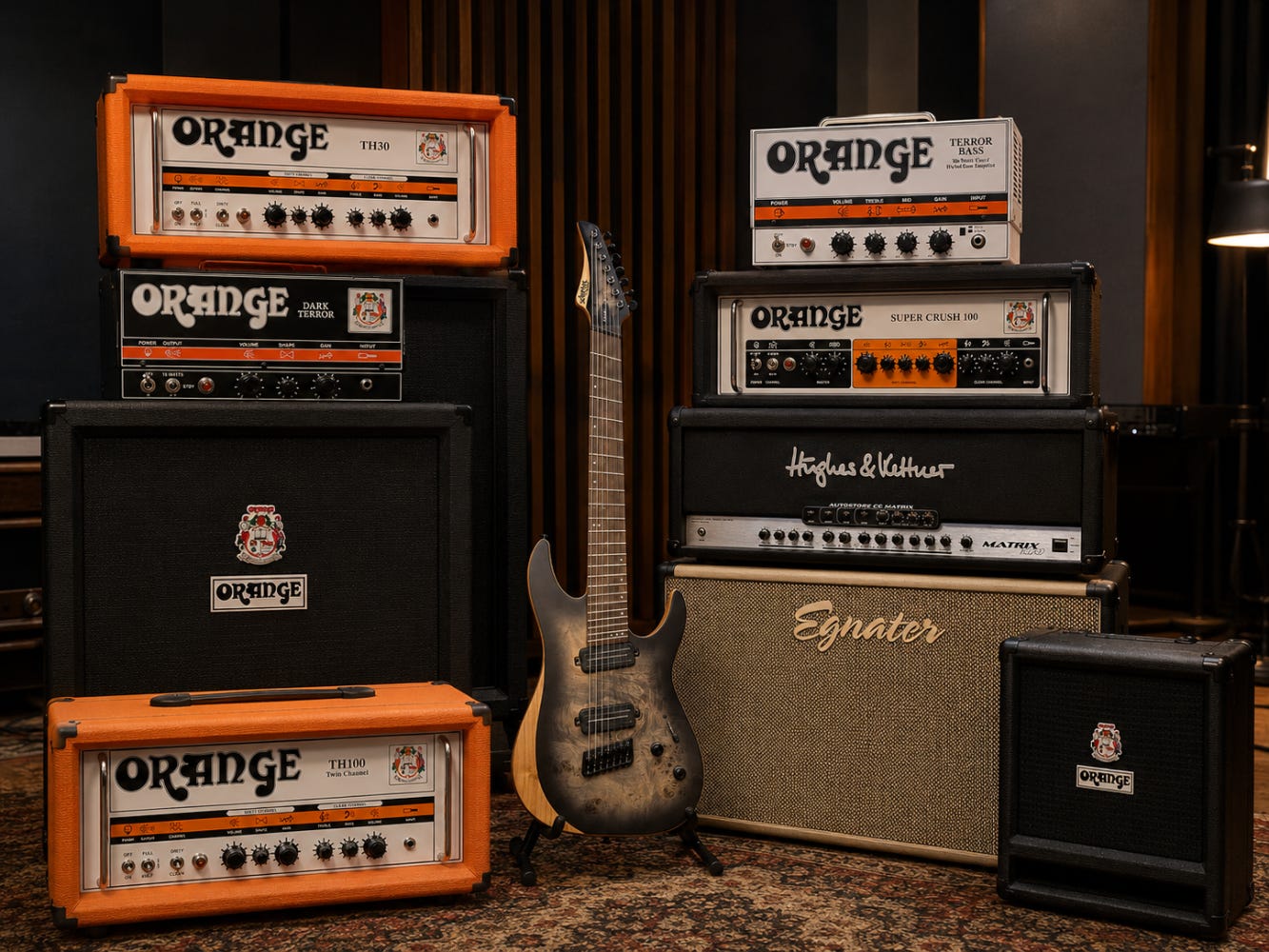
My collection of amps, and my Schecter Reaper-7 Multiscale, as re-imagined by AI
I play Schecter Guitar Research and ESP Guitar Co instruments because they have always worked for me. Merrell shoes because they hold up. Carhartt jeans for the same reason. Orange amps because of the “wow moment” I had, the first time I played through those British-voiced tubes. Walrus Audio pedals because you can feel the quality, and hear the difference. Apple because the whole product, from the unboxing to the update, feels intentional. That is taste, written down. We all know that change can be hard, and some people choose to avoid it, but I’m not avoiding change in these senses. Rather, what I am really avoiding is a guitar that doesn’t feel right, a pedal that does not fit my style, jeans that rip the first time I decide to go on a hike with my brother, and an amp that cannot blow the drywall screws right out of that mud patch.
I write like me, I build like me, I present like me. AI will never take that. But I want to be honest about the cost, because the cost is the point. It took more than fifteen years of reps to earn the eye that makes a sentence sound like mine, and the machine can hand a nineteen-year-old the finished render in a second now, the same render I learned to build by hand over months of clicks and keystrokes. The render was always the easy part. The eye for acceptable output was the work.
So use the tool. Let it do the clicks, the boilerplate, the tenth pass on something you already know cold. That is friction worth deleting, the 80% in the Pareto Principle. Just do not hand over the one rep that built everything else: looking at the work, finding the hair nobody else caught, and refusing to leave there. The instructor stopped walking the floor behind you a long time ago. Catching that stray hair is your job now.
For More on AI & Product Strategy: LinkedIn | Portfolio | Substack